They look the same but are so different
The automotive industry is experiencing the greatest changes since its inception more than 100 years ago.
The automotive industry is experiencing the greatest changes since its inception more than 100 years ago.
The electric revolution is in full swing and will soon arrive at dealership. Are you ready to sell electric cars? Do you know what makes them different from traditional car we know so well?
Take a look a few selected topics comparing a conventional internal combustion engine car and eletric vehicle.
Start learningElectric vehicles have and advantage thanks to simplicity of their design. What are the most significant differences in the construction of electric vehicles compared to internal combustion engine cars?
There are a number of engine placement configurations a car with a combustion engine can be built to ...
Car components such as the engine gearbox are spread out across the footprint of the car quite unevenly, encroaching on valuable cabin space and increasing the centre of gravity.
In an electric vehicle, car component are positioned much more efficiently, in a configuration that resembles a skateboard.
The battery pack is evenly placed as low as possible and the electric motors are installed low down and in between the front and rear wheels, pushing the centre of gravity down, which has a beneficial effect on handling and agility.
02
For most people, a new car purchase is a big-ticket investment. It doesn’t matter if they are purchasing the car for business or privately – they always carefully consider their purchase. It’s no surprise that purchase cost and residual value are among the top considerations.
Internal combustion engine vehicle (ICEV)
future
cost
The automotive manufacturing industry has been optimising its processes to maximise efficiency. Particularly in mass production like this, economies of scale help to push down the costs of parts, raw materials, etc.
With growing demand for electric cars, we can expect cost differences between electric and traditional cars to level out soon. In general, internal combustion engine cars retain their residual or resale value better than comparable battery electric, or plug-in hybrid vehicles.
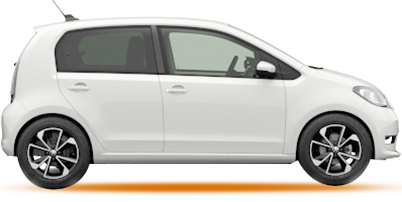
Battery electric
Vehicle (BEV)
It’s no secret that, at the moment, electric vehicles are more expensive to buy than their internal combustion engine counterparts.
However, the costs of electric vehicle technology have been rapidly dropping, and at ŠKODA we intend to sell electric cars for a price similar to the cost of equivalent internal combustion engine cars. If you factor in the total cost of ownership, electric cars are at an absolute advantage economically.
There are currently about 1.1 billion cars on roads around the world
In the name of environmental protection and climate change minimisation, the efficiency of propulsion will be a key determinant of viability for the future.
Internal combustion engine vehicle (ICEV)
3.1
According to the Environmental Protection Agency, in the last five years the fuel efficiency of the average car is up 16 per cent.
3.2
Modern diesel engines have efficiency of up to 40%.
3.3
Furthermore, there are technologies in development that have the potential to increase the efficiency of an internal combustion engine by 50%.
Electric cars’ drivetrains use fewer moving parts, generate less heat,
and therefore are a lot more efficient than internal combustion engines
whatever the conditions.
Internal combustion engine vehicle (ICEV)
3.4
The efficiency of the drivetrain has a significant impact on the overall efficiency of the vehicle. Since electric cars do not need multiple-speed transmissions, drive shafts and differentials, they encounter less resistance from components and move more freely. The efficiency of an electric motor is above 90%.
In the name of environmental protection and climate change minimisation, the efficiency of propulsion will be a key determinant of viability for the future.